
The events industry has entered a new phase, one where AI is now a structural necessity. In 2026, event management software (EMS) is evolving from a logistics tool into a predictive, automated growth engine.
Content creators and influencers are no longer satisfied with platforms that simply handle registration and ticketing. They expect intelligent systems that reduce manual work, eliminate data silos, and prove ROI in real time.
From smart data sync to automated lifecycle marketing, event tech is becoming deeply integrated, automated, and analytics-first. In this post, we explore how AI is reshaping event management software in 2026, and what automation trends modern organizers must prepare for.
Let’s begin.
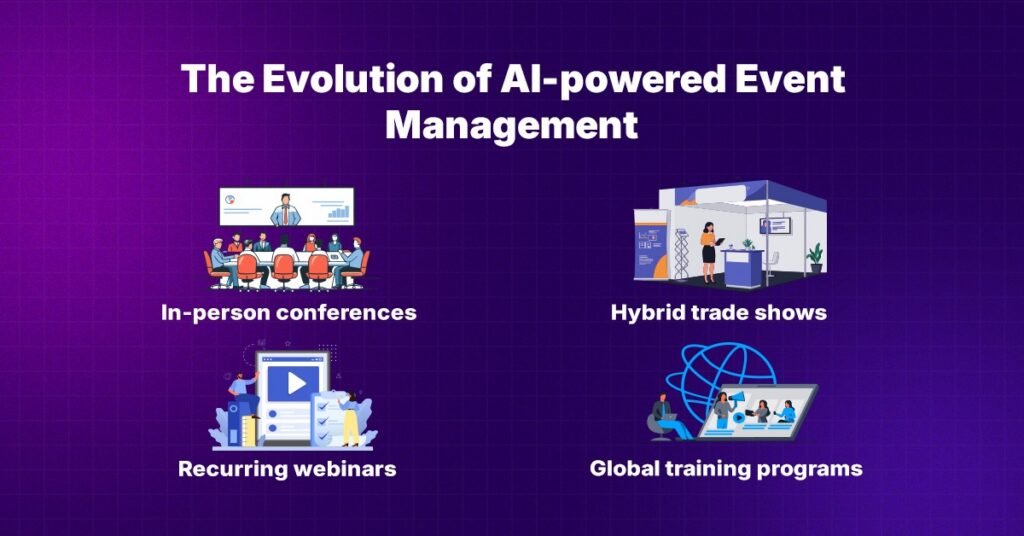
The Evolution of AI-Powered Event Management
Traditionally, EMS platforms focused on operational efficiency: event pages, badge printing, payment processing, and attendee tracking. But today’s demands are different. Modern teams manage:
- In-person conferences
- Hybrid trade shows
- Recurring webinars
- Global training programs
Managing this complexity requires the balance of automation powered by real-time intelligence. AI now sits at the core of event platforms, enabling:
- Predictive attendance forecasting
- Personalized agenda recommendations
- Real-time engagement analysis
- Closed-loop revenue attribution
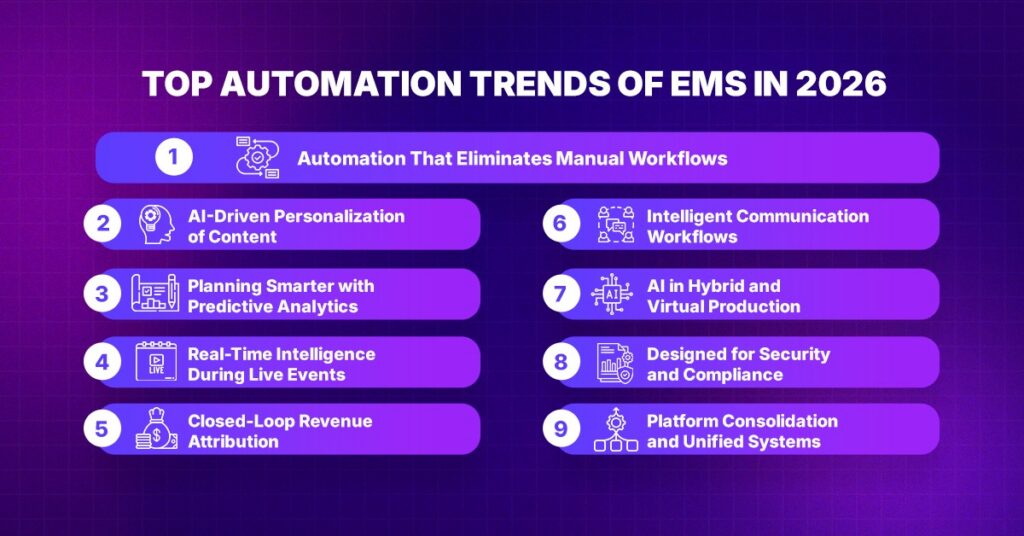
Top Automation Trends of EMS in 2026
1. Automation That Eliminates Manual Workflows
One of the biggest trends for 2026 is the disappearance of spreadsheet-driven event planning. In the past, organizers had to:
- Export registration data
- Reconcile payments manually
- Upload attendee lists to CRM
This fragmented workflow slowed down teams and introduced errors.
AI-powered event platforms now automate the entire data flow:
Registration → Payment → CRM Record Creation → Engagement Tracking → Attribution Reporting
All in real time. No middleware. No delayed syncs. No manual exports.
Automation ensures that finance, marketing, and sales teams operate from a single source of data.
2. AI-Driven Personalization of Content
In 2026, personalization is not optional, but is essential to succeed. AI enhances attendee experiences by analyzing registration data, past behavior, and engagement patterns to recommend:
- Relevant sessions
- Suggested networking matches
- On-demand content
For example, a marketing leader attending a SaaS conference may receive AI-curated sessions focused on revenue growth.
3. Planning Smarter with Predictive Analytics
When planning becomes data-driven, risk decreases and ROI increases, and this is where predictive analysis comes in. Modern EMS platforms analyze historical event data to predict:
- Registration velocity
- Expected attendance vs. no-show rates
- High-demand sessions
- Revenue forecasts
- Sponsor engagement potential
Instead of guessing room capacity or staffing levels, organizers can rely on predictive models. This reduces operational waste and helps optimize:
- Venue selection
- Marketing budgets
- Speaker scheduling
4. Real-Time Intelligence During Live Events
AI transforms static planning into responsive management. In 2026, events are dynamic ecosystems and AI allows organizers to adapt in the moment. Real-time dashboards now display:
- Live check-ins
- Session occupancy rates
- Poll and Q&A participation
If engagement drops during a session, organizers can:
- Push reminders
- Extend interactive segments
- Promote alternative sessions
5. Closed-Loop Revenue Attribution
Perhaps the most important AI evolution is in ROI measurement. Executives no longer accept vague reports about attendance or satisfaction. They demand:
- Pipeline influenced
- Revenue generated
- Deal acceleration rates
EMS platforms now connect event actions directly to CRM opportunities.
For example:
- Registration → Lead Creation
- Session Attendance → Engagement Score
- Demo Request → MQL
- Follow-up Meeting → Opportunity Creation
- Closed Deal → Revenue Attribution
With AI-enhanced attribution models, every event touchpoint can be traced to pipeline impact. This allows event budgets to be defended with confidence.
6. Intelligent Communication Workflows
Communication automation is becoming more advanced and more personalized. AI-powered EMS platforms now support:
- Email triggers
- SMS reminders
- Automated post-session surveys
- Personalized re-engagement campaigns
These automations reduce no-show rates and extend event value beyond the event date.
7. AI in Hybrid and Virtual Production
Hybrid events remain a key format in 2026. As hybrid production increasingly mirrors broadcast-quality standards, automation ensures consistency, accessibility, and reliability. It ensures that remote participants can become active contributors and enhances experiences by:
- Improving engagement between virtual and onsite attendees
- Enabling live captioning and multilingual translation
- Providing adaptive content streams
8. Designed for Security and Compliance
As event data grows richer, security expectations increase. AI-driven EMS platforms now embed:
- PCI Level 1 payment compliance
- SOC2 and GDPR controls
- Automated consent tracking
- Role-based access permissions
This becomes especially critical for regulated industries like healthcare, fintech, and enterprise tech.
9. Platform Consolidation and Unified Systems
A defining trend for 2026 is the shift from fragmented point tools to unified platforms. Instead of using:
- Separate registration software
- Independent payment portals
- External CRM connectors
- Third-party BI dashboards
Organizations are choosing consolidated EMS platforms that integrate everything into one system. The benefits are clear:
- Reduced reconciliation time
- Fewer data errors
- Faster reporting
- Lower operational costs
- Better executive visibility
The Strategic Shift: AI as a Budget Multiplier
Data-driven event teams consistently secure larger budgets. When engagement and ROI can be measured in real time, organizers gain confidence in event spend. AI-powered analytics demonstrate:
- Engagement growth
- Pipeline creation
- Revenue acceleration
- Sponsor performance
What to Watch Next?
Looking ahead, innovation will likely focus on:
- Advanced predictive no-show modeling
- Deeper AI-driven personalization
- Multilingual real-time translation
- Behavioral scoring tied directly to sales pipeline
To sum up, the future of AI in event management software is about more than automation.
It’s about replacing guesswork with intelligence.
It’s about eliminating middleware and fragmented workflows.
It’s about proving ROI in real time.
And most importantly, it’s about transforming events from isolated experiences into measurable, scalable growth engines.
Helpful ServvAI Resources for AI event management software
If you are exploring AI event management software, the ServvAI blog has more ideas on events, appointments, creator revenue, product education, and customer experiences.
Shopify merchants can review the ServvAI Shopify app, while WordPress and WooCommerce users can explore the ServvAI WordPress plugin for event booking and scheduling workflows.